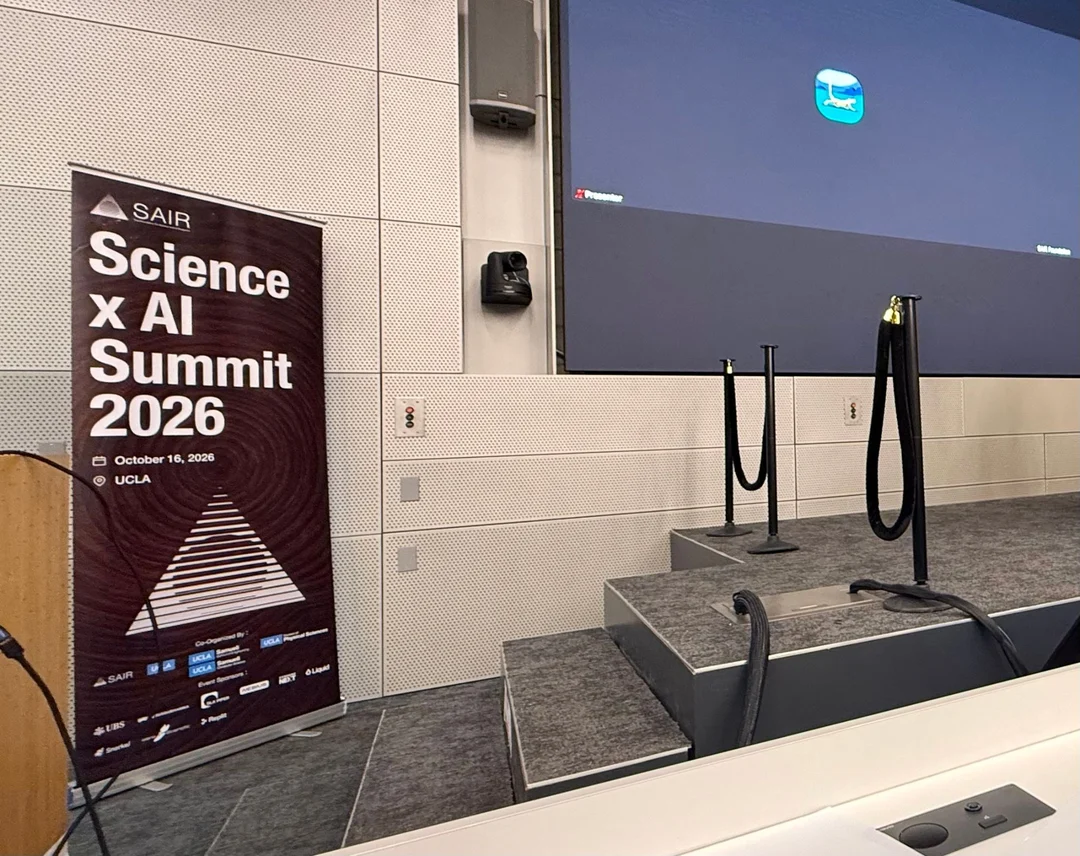
I attended UCLA’s Science x AI Summit today, excited to hear how some of the world’s leading thinkers see the future of scientific discovery. Then Fields Medalist Yu Deng walked in and sat next to me! But what stayed with me most was a bigger question: what happens when AI becomes more capable than us in every way?
OpenAI released 722 mathematical manuscripts addressing research problems just two weeks ago, sending shockwaves through mathematics and beyond. There is a growing sense that “math is being solved”—that problems researchers expected to spend years working on might now yield to AI in hours. I was especially eager to hear what the speakers thought.
To me, some of the responses felt a little defensive, though the distinction they drew was important. Mathematics involves more than solving known problems. It also means inventing concepts, finding connections, and figuring out which questions are worth asking. Still, I kept wondering: how long will that distinction hold? If AI becomes better at answering our questions, could it eventually become better at asking them, too?
Tao also raised a paradox I keep returning to: faster research could actually slow scientific progress. Science depends on people sharing unfinished ideas and asking questions openly. But if mathematicians worry that an AI company could take their questions, solve them, and publish first, they may become more reluctant to share. Even talking to an AI agent could feel like giving away the seed of their next paper. That would be a strange outcome: we build tools that make discovery faster, and people become less willing to share the ideas that make discovery possible.
My takeaway is that, at least for now, one of the biggest bottlenecks in what we can do with AI may be our own imagination. As answers become easier to obtain, choosing the right questions becomes even more important. Which assumptions should we challenge? What connections have we missed? What would we try if something that once took years could now be explored in days? And how much are we limiting ourselves by asking AI to do only the things we already know how to imagine?
All the theoretical fields, where progress does not have to wait for physical experiments, may face this shift especially quickly. Researchers may soon find themselves working alongside systems that outperform them at much of what they spent their careers learning to do. In experimental fields like biology, the revolution is also beginning, though predictions still have to be tested in living systems.
I’m especially excited about what this could mean for understanding our genome. Imagine being able to completely understand our genome: how life works, why things go wrong, and how we might intervene. We could find new ways to treat cancer, prevent disease, and understand processes that have puzzled us for decades. Perhaps one day we could even “vibe code” a new form of life—describe what we want a biological system to do, then work with AI to design and test something that has never existed before. In essence, there could be one day when we are creating “God”. How comfortable would we be with that?
That brought me back to one of the day’s most provocative questions, posed by Po-Shen Loh, the former head coach of the U.S. International Mathematical Olympiad team. In essence: has a species vastly more capable than another ever willingly surrendered control to it? As far as we know, the answer is no. AI could become something like the first non-carbon-based species we have ever encountered—one we created ourselves. And we are building it to potentially surpass us across almost every domain, while assuming we will still be the ones in control.
What gives us confidence in that assumption? And how would we recognize the moment when our ability to direct these systems starts falling behind their ability to act?
Loh put it in a way I’ll remember:
“Driving a car faster than you can run is fine. But not faster than you can steer.”
I left the summit very excited about what we might discover: breakthroughs in mathematics, deeper insights into biology, and treatments we cannot yet imagine. And yes, I’m fully convinced that many Nobel Prizes are going to come out with the help of AI. I also left thinking about how much we need to grow alongside these tools—in our imagination, our willingness to share ideas, and our judgment about what to do with the answers.
I want to see how far AI can take us. AI could bring breakthroughs to every part of our lives, and many the problems that have puzzled us for centuries may soon be addressed. At the same time, I hope we can understand what we find along the way—and keep a say in where we’re going.
Oct 16 2026 in Los Angeles